Publications
You can also have a look at my scholar profile
2025
-
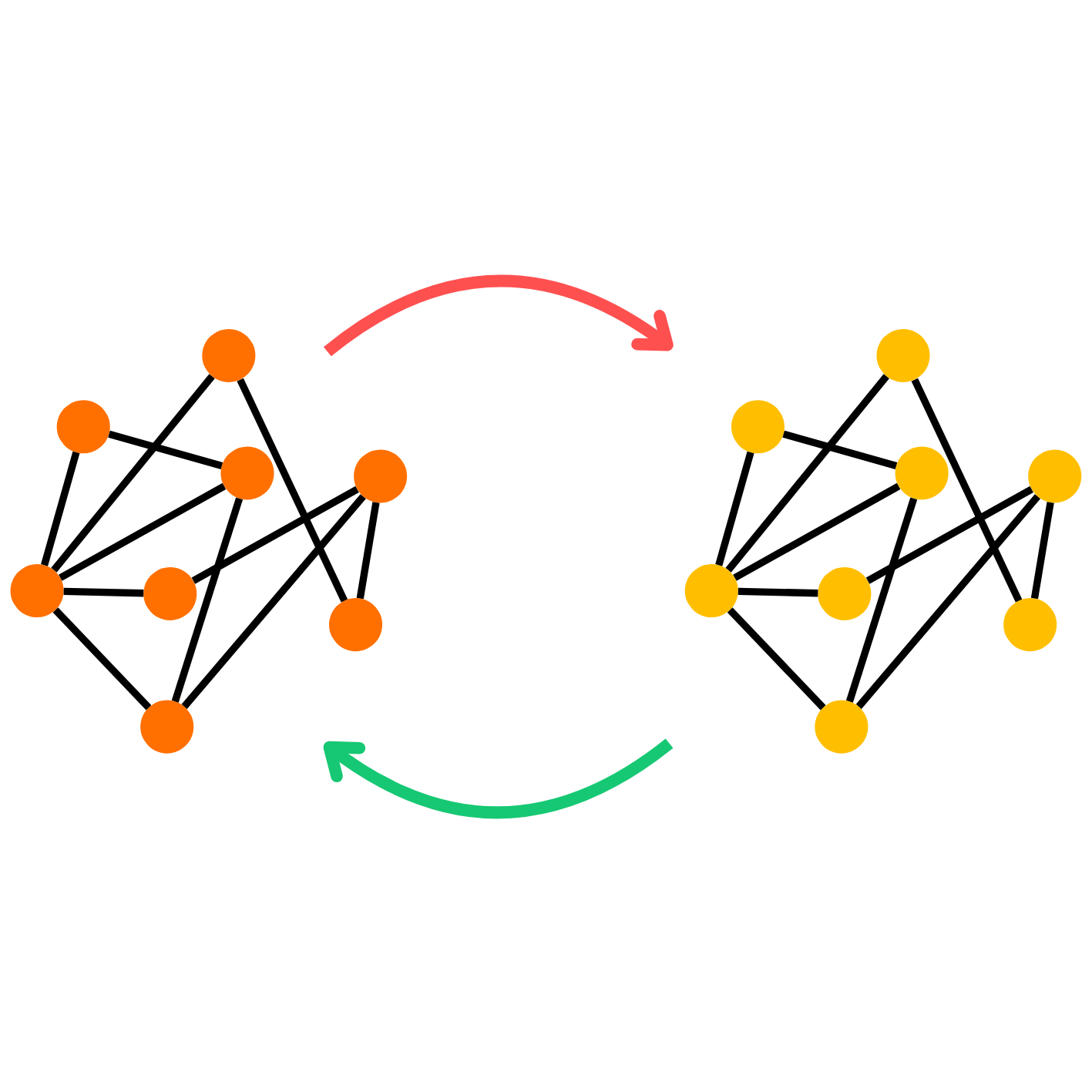 Coupling complex systems: from ecological metacommunities to nonreciprocal interactionsGiulia Garcia LorenzanaUniversité Paris Sciences et Lettres , Jun 2025
Many complex systems — from ecological communities to neural networks, and from large economies to spin-glasses — are composed of many simple components interacting in a heterogeneous way. These systems can exhibit surprising emergent behavior which can be studied with the tools of statistical physics. However, little is known about what happens when two — or many — of such complex systems are coupled together, a general situation that can arise whenever there are multiple levels of organization. In this thesis, I study two cases for which such a framework is relevant. The first is a diverse ecological meta-community, a network of local ecological communities (each composed of many interacting species), interconnected by migration of individuals. While in an isolated community fluctuations would lead to the progressive extinctions of all species, the spatial network enables the compensation of local extinctions by recolonizations. I have shown that the presence of heterogeneous interactions stabilizes the ecosystem in conditions in which an isolated species would go extinct. This is possible thanks to the spontaneous emergence of mutualistic interactions. However, this same mechanism induces a tipping point, beyond which the ecosystem collapses, shifting from high diversity to extinction of all species. I have identified probes that enable to predict this tipping point before it occurs. In the second part of the thesis, I describe the effect of non-reciprocal interactions on pairs of complex systems. Disordered systems can undergo a glass transition, after which they exhibit aging: the older the system is, the slower it evolves. Previous studies have long suggested that non-reciprocity tends to destroy glassiness, generating instead chaotic dynamics. Studying a bipartite spherical Sherrington-Kirkpatrick model I was able to show that this is not always the case. I uncovered an exceptional-point mediated transition from a static disordered phase to an oscillating amorphous one, characterized by non-reciprocal aging with slow dynamics and oscillations. I have also developed a series of criteria to determine whether adding small non-reciprocal interactions to a system undergoing a phase transition would change its critical behavior.
-
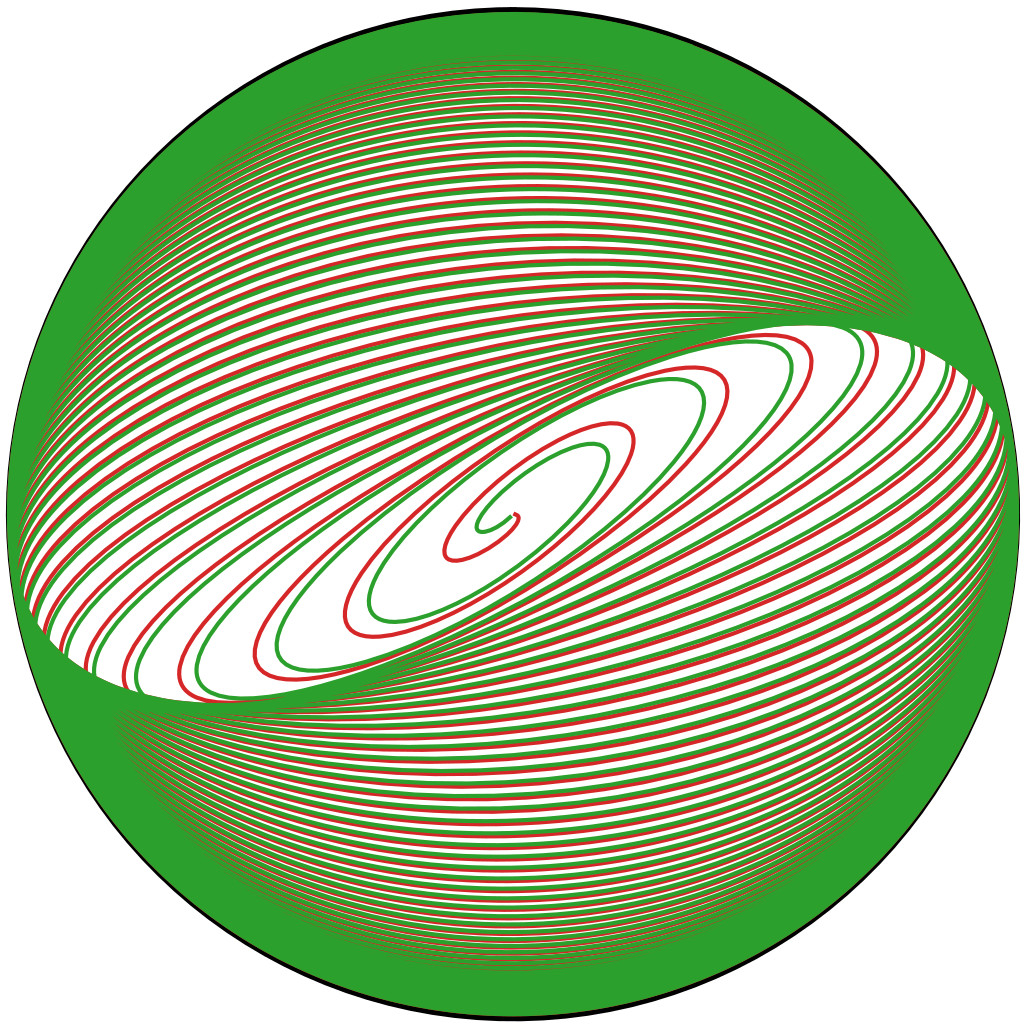 Nonreciprocal Spin-Glass Transition and AgingGiulia Garcia Lorenzana , Ada Altieri , Giulio Biroli , Michel Fruchart , and Vincenzo VitelliPhysical Review Letters, Jun 2025
Disordered systems generically exhibit aging and a glass transition. Previous studies have long suggested that non-reciprocity tends to destroy glassiness. Here, we show that this is not always the case using a bipartite spherical Sherrington-Kirpatrick model that describes the antagonistic coupling between two identical complex agents modeled as macroscopic spin glasses. Our dynamical mean field theory calculations reveal an exceptional-point mediated transition from a static disorder phase to an oscillating amorphous phase as well as non-reciprocal aging with slow dynamics and oscillations.
-
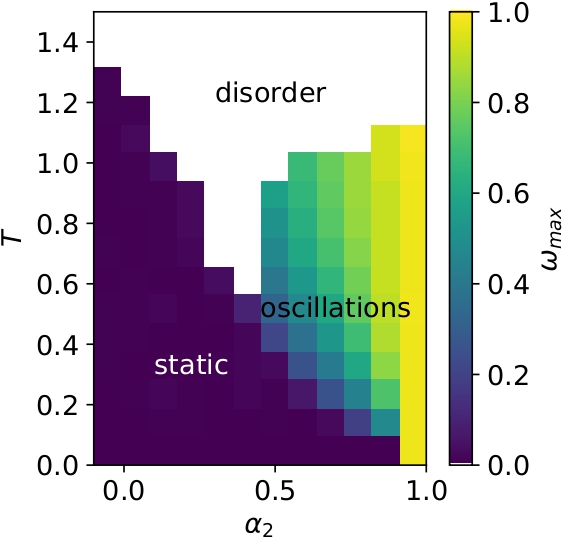 Nonreciprocally coupled spin glasses: Exceptional-point-mediated phase transitions and agingGiulia Garcia Lorenzana , Ada Altieri , Giulio Biroli , Michel Fruchart , and Vincenzo VitelliPhysical Review E, Jun 2025
Disordered systems can exhibit a dramatic slowdown of their dynamics called aging. Contrary to the established understanding that this phenomenon is destroyed by nonreciprocal interactions, we here show that the outcome crucially depends on the structure of the system. Unlike previous studies, which focused on random nonsymmetric interactions between simple microscopic components, we investigate a scenario where nonreciprocally coupled agents are macroscopic entities with complex internal dynamics, modeled as two identical spin glasses. This framework could be relevant for many biological systems, in which nonreciprocal interactions can arise at a coarse-grained level. Our dynamical mean-field theory calculations reveal a finite temperature transition from a static disordered phase to a non-time-translationally-invariant regime. Below this transition, mediated by a spectral singularity known as exceptional points, we find macroscopic oscillations superimposed on aging behavior. Asymptotically, the system rotates in the plane spanned by the two lowest energy modes of the uncoupled system. We contrast these results to the case of random nonreciprocity, where aging is suppressed at any finite temperature, and propose that the two cases correspond to two broader classes of systems, with “microscopic” versus “macroscopic” nonreciprocity, with aging surviving only in the second case.
-
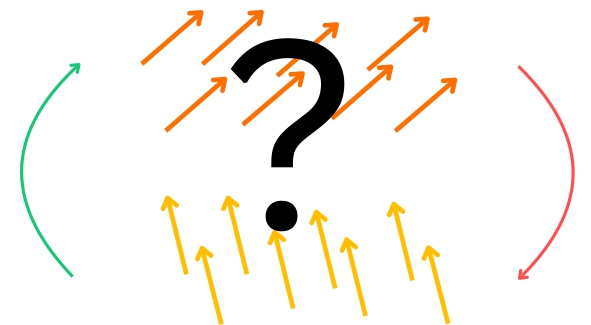 When is nonreciprocity relevant?Giulia Garcia Lorenzana , David Martin , Yael Avni , Daniel S. Seara , Michel Fruchart , Giulio Biroli , and Vincenzo VitelliJun 2025
Nonreciprocal interactions are widely observed in nonequilibrium systems, from biological or sociological dynamics to open quantum systems. Despite the ubiquity of nonreciprocity, its impact on phase transitions is not fully understood. In this work, we derive criteria to perturbatively assess whether nonreciprocity changes the universality class of pairs of asymmetrically coupled systems undergoing a phase transition. These simple criteria are stated in terms of the unperturbed critical exponents, in the spirit of the Harris criterion for disordered systems, and agree with numerical simulations. Beyond nonreciprocity, our approach provides guidelines for assessing how dynamical phase transitions are affected by perturbations.


2024
-
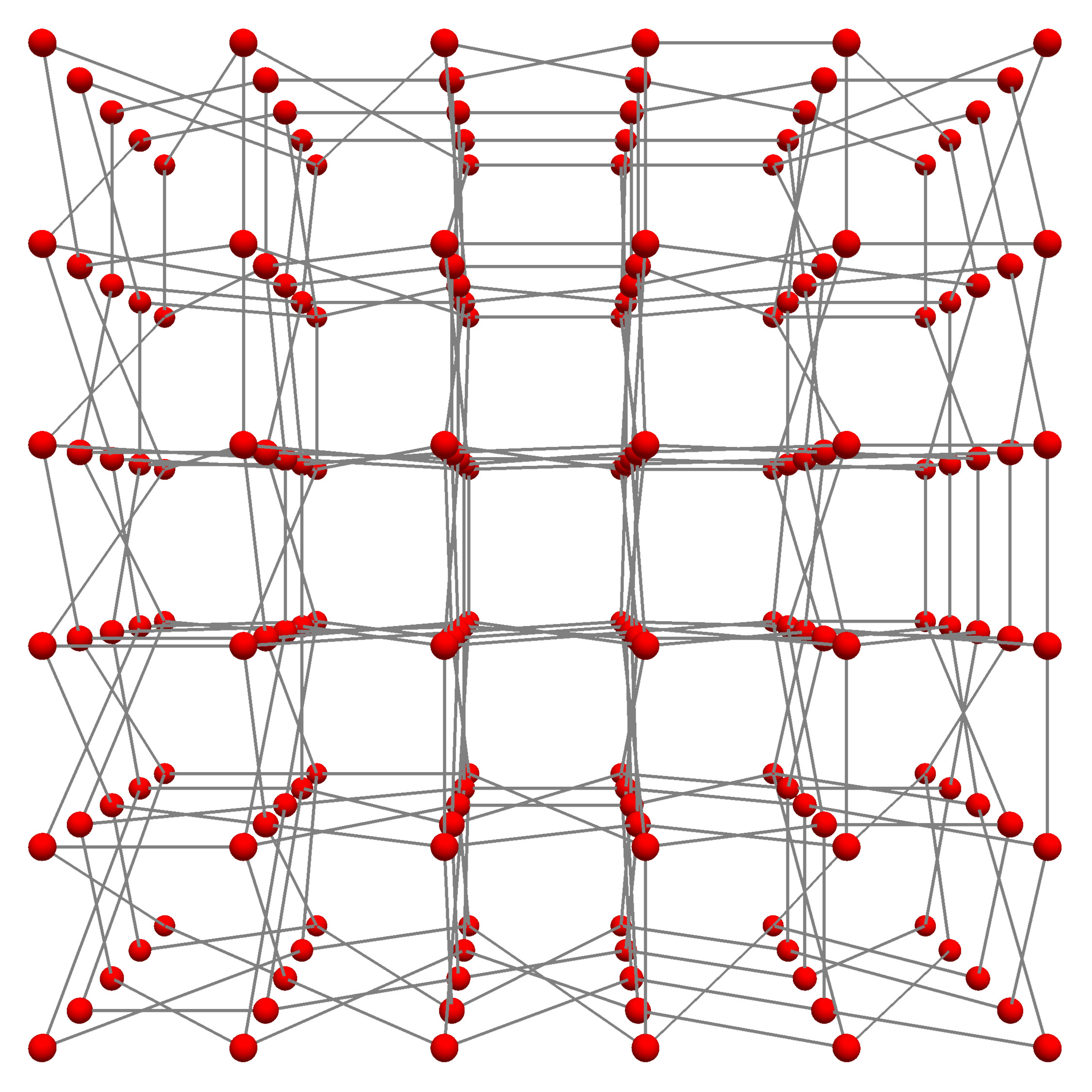 Corrections to the Bethe lattice solution of Anderson localizationMatilde Baroni , Giulia Garcia Lorenzana , Tommaso Rizzo , and Marco TarziaPhysical Review B, May 2024
We study numerically Anderson localization on lattices that are tree-like except for the presence of one loop of varying length 𝐿. The resulting expressions allow us to compute corrections to the Bethe lattice solution on (i) random-regular-graph (RRG) of finite-size 𝑁 and (ii) Euclidean lattices in finite dimension. In the first case we show that the prefactor of the 1/𝑁 corrections to the average values of the typical density of states diverges exponentially approaching the critical point. In the second case our results, combined with the 𝑀-layer expansion, predict that corrections destroy the exotic critical behavior of the Bethe lattice solution in any finite dimension, strengthening the suggestion that the upper critical dimension of Anderson localization is infinity. Our approach explains the puzzling observation that the numerical simulations on finite RRGs deviate spectacularly from the expected asymptotic behavior, and opens the way to the computation of non-mean-field critical exponents by resumming the series of diverging diagrams through the same recipes of the field-theoretical perturbative expansion.
-
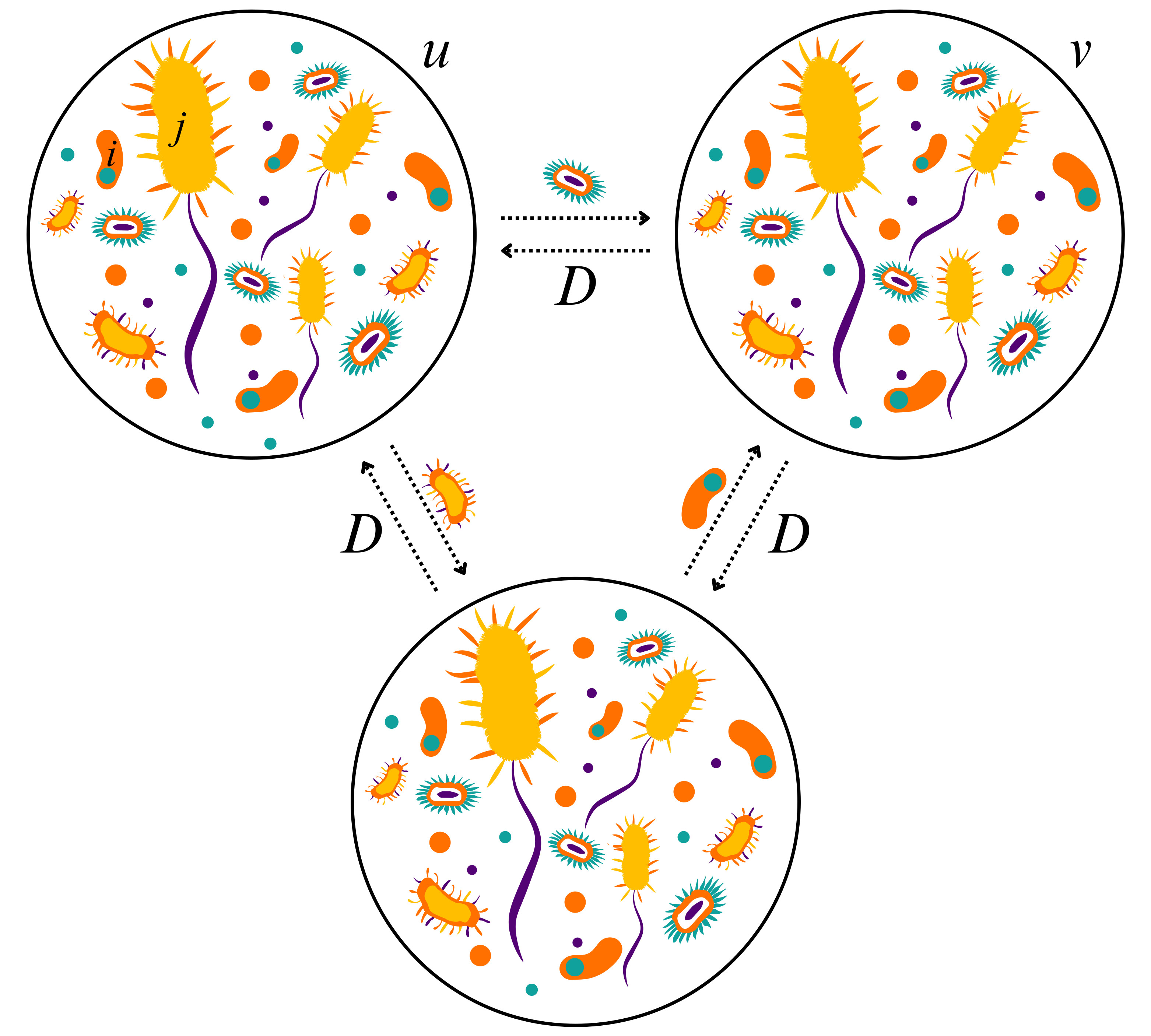 Interactions and Migration Rescuing Ecological DiversityGiulia Garcia Lorenzana , Ada Altieri , and Giulio BiroliPRX Life, Mar 2024
How diversity is maintained in natural ecosystems is a long-standing question in Theoretical Ecology. By studying a system that combines ecological dynamics, heterogeneous interactions, and spatial structure, we uncover a new mechanism for the survival of diversity-rich ecosystems in the presence of demographic fluctuations. For a single species, one finds a continuous phase transition between an extinction and a survival state, that falls into the universality class of Directed Percolation. Here we show that the case of many species with heterogeneous interactions is different and richer. By merging theory and simulations, we demonstrate that with sufficiently strong demographic noise, the system exhibits behavior akin to the single-species case, undergoing a continuous transition. Conversely, at low demographic noise, we observe unique features indicative of the ecosystem’s complexity. The combined effects of the heterogeneity in the interaction network and migration enable the community to thrive, even in situations where demographic noise would lead to the extinction of isolated species. The emergence of mutualism induces the development of global bistability, accompanied by sudden tipping points. We present a way to predict the catastrophic shift from high diversity to extinction by probing responses to perturbations as an early warning signal.


2022
-
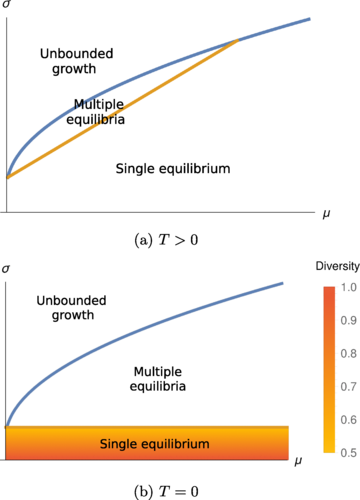 Well-Mixed Lotka-Volterra Model with Random Strongly Competitive InteractionsG. Garcia Lorenzana , and A. AltieriPhysical Review E, Feb 2022
The random Lotka-Volterra model is widely used to describe the dynamical and thermodynamic features of ecological communities. In this work, we consider random symmetric interactions between species and analyze the strongly competitive interaction case. We investigate different scalings for the distribution of the interactions with the number of species and try to bridge the gap with previous works. Our results show two different behaviors for the mean abundance at zero and finite temperature, respectively, with a continuous crossover between the two. We confirm and extend previous results obtained for weak interactions: at zero temperature, even in the strong competitive interaction limit, the system is in a multiple-equilibria phase, whereas at finite temperature only a unique stable equilibrium can exist. Finally, we establish the qualitative phase diagrams and compare the species abundance distributions in the two cases.
